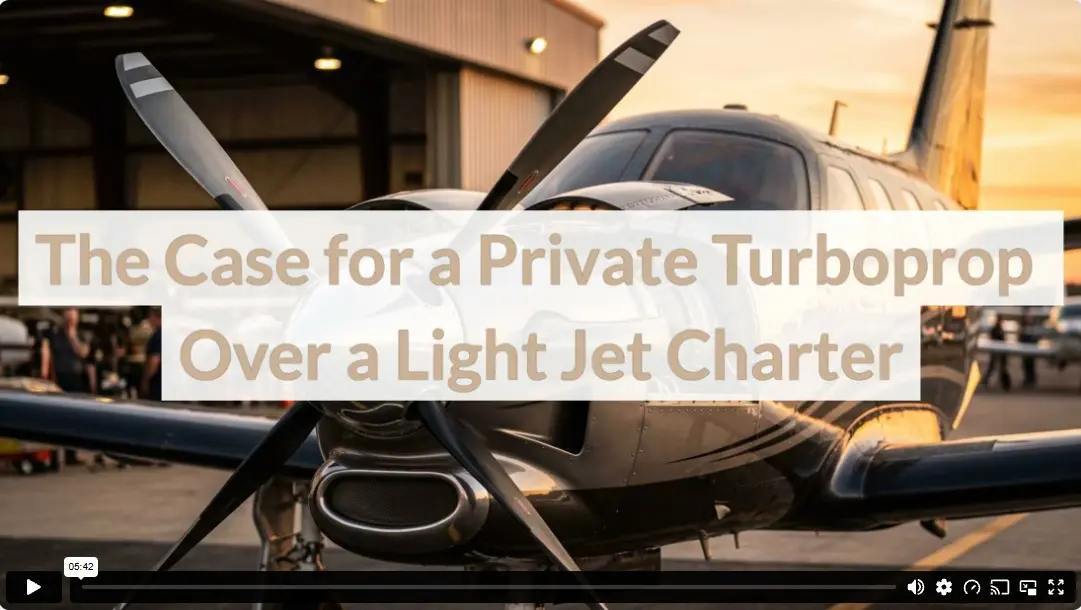

For most regional private travel, a light jet is the default booking. It’s faster than a turboprop, widely available, and consistent with the mental model of what a well-resourced trip should look like. The problem is that “faster on paper” and “better for this specific trip” are two different things, and they don’t always lead to the same conclusion.
A private turboprop charter occupies a different category than a light jet, and on some routes, it performs better on total trip time, destination access, weather adaptability, and reliability. Understanding when that’s true can help you make a more strategic aircraft selection.
The Variables That Shape Aircraft Choice
Light jets are faster, pressurize at higher altitudes, and carry more range on most routes.
What a spec sheet doesn’t tell you is how those distinct advantages apply to your specific trip conditions. The variables that determine how a light jet performs are the runway length at the destination, the quality of airport infrastructure at both ends, the terrain and weather characteristics of the route, and how much of the speed advantage survives the full door-to-door time calculation.
On many routes, a light jet charter rental wins on all of those. However, on some routes, it doesn’t. Comparing the actual trip parameters against those filters is what surfaces the right aircraft.
The trips where turboprops can perform better tend to follow a recognizable pattern. They include destinations somewhat off the main aviation grid, routes that run through variable weather or terrain, and schedules where total trip time matters more than airborne time.
In these cases, turboprops gain an advantage because operational constraints matter more than cruise speed. These trips are common for executives traveling to regional markets or managing site visits that do not begin and end at major city airports.
Short Runways and the Airport Access Advantage
The most direct advantage a turboprop holds over a light jet is where it can land. A light jet typically requires 4,000 to 5,000 feet of runway to operate safely at full load. The Pilatus PC-12, the benchmark executive turboprop, operates comfortably from runways under 2,500 feet and handles unpaved or grass strips that light jets cannot use.
That difference matters on more routes than you might think. Destinations near mountain communities, ranch land, coastal properties, or rural business sites are frequently served by airports that fall outside a light jet’s viable runway list.
The nearest jet-capable airport can be 45 minutes to an hour from the actual destination by car, meaning the ground transportation that follows erodes the time savings the jet delivers. Because the PC-12 can land at a shorter-field airport closer to the destination, its door-to-door time often matches or beats that of the light jet.
Smaller fields used by turboprops typically involve shorter taxi times, simpler handling, and less wait at the FBO compared to the busier airports light jets depend on. Those advantages are hard to ignore when you experience them at both ends of the trip.
Low-Altitude Routing and Weather Resilience
Light jets perform at their best at high cruise altitudes, where they can maximize speed and fuel efficiency. When weather, terrain, or airspace require lower altitude routing, the jet doesn’t run as efficiently. The speed advantage narrows, and flight conditions can change.
The PC-12 is designed for exactly those conditions. Its single-engine turbine configuration handles low and mid-altitude routing without a meaningful performance penalty, and its short-field capability opens flexible alternate airport options when a primary destination becomes unavailable due to weather.
Some travelers hesitate to book a single engine option. However, the turbine engine that powers the PC-12 has decades of documented operational reliability across military, medical, and commercial operations worldwide. For routes that move through mountain terrain, coastal weather systems, or low-altitude corridors, the turboprop’s performance profile fits better than a jet operating outside its optimal altitude band.
The Total Trip Time Calculation
Speed comparisons between light jets and turboprops usually stop at cruise speed. A light jet at 420 knots against a PC-12 at 270 knots looks decisive. On a 600-mile trip, the cruise speed difference adds roughly 40 minutes to the turboprop’s airborne time.
But that 40 minutes deserves context.
Your full travel time includes a lot more than just airborne time. It includes the drive to the departure airport, handling, boarding, taxi, climb to cruise altitude, descent, landing, and the ground transfer to the final destination. The jet’s speed advantage lives entirely in the airborne phase. At the ground level, airport proximity determines how much of that advantage survives by the time you reach your actual destination.
A shorter drive to a closer departure airport and a more convenient arrival field that puts you directly adjacent to the destination can together account for a significant time savings. On routes under 600 miles where the turboprop accesses tighter fields and the jet cannot, the door-to-door math frequently runs in the turboprop’s favor.
For executive teams running regional loops across multiple locations in a single day, this calculation should be applied to each leg rather than assumed in advance.
Aircraft Selection is a Strategic Decision
Private travelers who default to light jets on every trip are selecting their aircraft by category rather than fit. That’s one approach, but it means paying the jet premium on routes where the turboprop often produces a better outcome.
The right aircraft is not always the one that performs best in general. It’s the one that performs best for this specific trip, measured by door-to-door time rather than airborne speed. Whether it has one engine or two is secondary to whether it fits the flight. The executives who get the most out of private aviation are the ones who consider aircraft selection route by route to find the best fit for each trip.
Video