
Most companies don’t actively choose to stick with self-service booking tools. They just never consider changing how they schedule travel. But as trips get more complex, the stakes get higher, and the process that worked in the early days stays in place because no one has had a reason to question it.
Self-service platforms can work well for simple travel needs, such as a one-day trip to Miami. But when your travel involves more destinations or stops on a tighter itinerary, you need a better system. It may not be obvious at first. For many businesses, it shows up in small friction points that grow over time.
Here are the signs that your travel has outgrown what a self-service tool can properly manage.
1. Your Team is Spending Time Managing Flights
An executive assistant begins monitoring connections after a booking is made. A traveler handles their own re-routing when a flight gets disrupted. Someone checks fares across three platforms before committing to a price because they’re not confident the listed rate is the best available.
This kind of work feels minor in isolation. One rescheduled flight, upgrade request, or itinerary change isn’t much on its own, but they add up. When your team is regularly absorbing travel logistics that a travel partner would handle automatically, you’re paying for a labor cost that doesn’t support your company’s actual needs.
Self-service tools let you book a flight. They don’t monitor the booking after it’s made or proactively manage changes. That gap between booking and managing is where most of the hidden costs live.
2. You’re Paying Public Fares When Private Fares Exist
Most travelers assume that what a booking platform shows them represents the best available price. It doesn’t. The fares listed on consumer platforms are publicly available rates. A significant portion of discounted first-class and executive-grade business-class airfares never appear there at all.
Private fares exist because airlines negotiate separately with high-volume travel partners. These rates don’t get published. They’re accessible only to companies with the industry relationships and booking volume needed to earn access. For a single ticket, the difference can be hundreds of dollars. Across a full quarter of executive travel, the difference can grow significantly.
If your team regularly books premium cabin seats on long-haul international routes to London, Dubai, Tokyo, or Sydney, and they’re doing it through a consumer platform, there’s a good chance they’re paying more on bookings. A travel partner with access to private jet charter pricing may be able to offer savings on flights without changing how you travel.
3. Last-Minute Bookings Have Become a Liability
Business moves quickly, and travel schedules follow. When a deal closes late or a key meeting gets added on short notice, a self-service platform may present limited options.
Consider what a last-minute international booking actually looks like through a self-service tool. You’re searching publicly available inventory and paying whatever the current demand rate is. You may have to make trade-offs on routing or cabin class because the ideal option isn’t showing up. If you need a same-day charter instead, you’re starting from scratch on a platform that wasn’t designed for that.
A travel partner can move quickly and keep your schedule intact in ways a self-service platform simply can’t. The flexibility is built into the relationship. It’s not something you have to engineer on your own at the last minute.
4. Your Itineraries Have Too Many Moving Parts
A direct domestic flight is straightforward to book. An international trip involving a long-haul business class flight, hotel accommodations, airport transfers in a city you’ve never visited, and a connecting leg home is not. Self-service tools ask you to assemble those pieces yourself across separate platforms and points of failure.
Think through what happens when one piece breaks. Your flight lands late, and the car service has moved on. Your hotel has a check-in cutoff, and no one flagged it. Your connecting flight has a tighter window than it looked on paper. Each of those is a fixable problem, but fixing it requires time and attention you may not have at that moment.
When a travel partner coordinates the whole itinerary, the pieces fit together. Someone is watching for the downstream effect when one part changes. That’s a fundamentally different experience from assembling the same trip through three separate platforms and hoping the timing holds together. The more legs, cities, and services your trips involve, the more that coordination helps.
5. Premium Travel Is Now Part of How You Operate
There’s a real difference between booking a flight and managing a travel program. When business class, private charter, or curated accommodations have become a regular part of how your company operates, a consumer booking platform isn’t the right infrastructure for it.
Part of the shift is practical. A travel partner who knows your account can anticipate your needs without a full briefing every time. They know your usual carriers, your seat preferences, which airports work best for your home city, and what your team’s standard itinerary looks like. That context makes every booking faster and reduces the back-and-forth that self-service tools can’t eliminate.
Part of the shift is operational. When premium travel is routine, the way you book it should reflect how your company operates. A seamless, concierge-level experience from the first contact to wheels down is a different standard than navigating a booking platform at 11pm before an early departure. The right partner makes that standard the default, not something you have to work to achieve.
6. You’ve Had a Trip Go Wrong With No One to Call
A canceled flight. A missed connection. A hotel that fell through the night before an important meeting. If you’ve ever been in that situation with a hold queue between you and a resolution, you already know what the gap costs.
Self-service platforms offer customer service, but it’s general by design. The person on the other end doesn’t know your preferences or the full context of the trip. They’re working with the same information you have. A dedicated travel expert who knows your account can see the whole picture and act on it by rerouting, rebooking, or escalating.
The difference between a long wait on a general customer service line and a direct line to someone who knows your account isn’t small.
A Travel Partner Makes the Difference
When business travel becomes increasingly complex, you can quickly outgrow the tools that served your early needs. The right travel partner gives you access to private, non-publicly-listed fares on business and first-class commercial flights. They can source private jet charters when commercial routes don’t fit the itinerary. And they coordinate hotels, ground transportation, seat selection, and visa assistance through one person who knows your account and preferences.
Over time, that level of support can turn travel from a series of transactions into a more seamless experience tailored to the needs of frequent flyers and growing organizations.
Video

Infographic
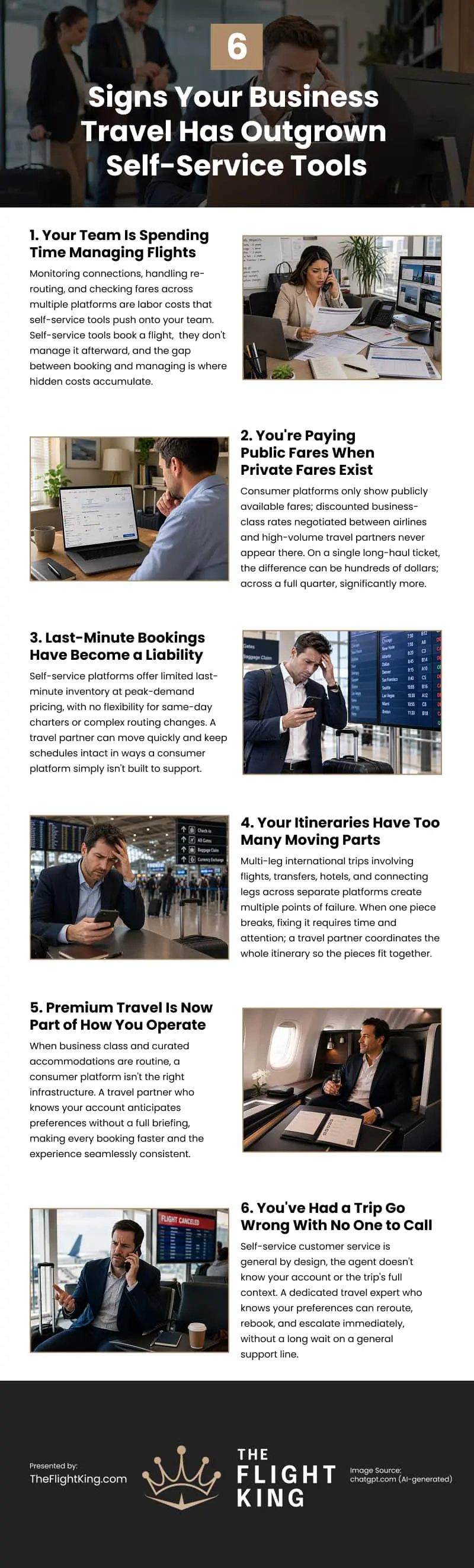
Self-service booking platforms work well for simple trips, but the friction points that signal they’ve been outgrown are easy to miss until the costs have already quietly accumulated. Discover signs your business travel has outgrown self-service tools in this infographic.