
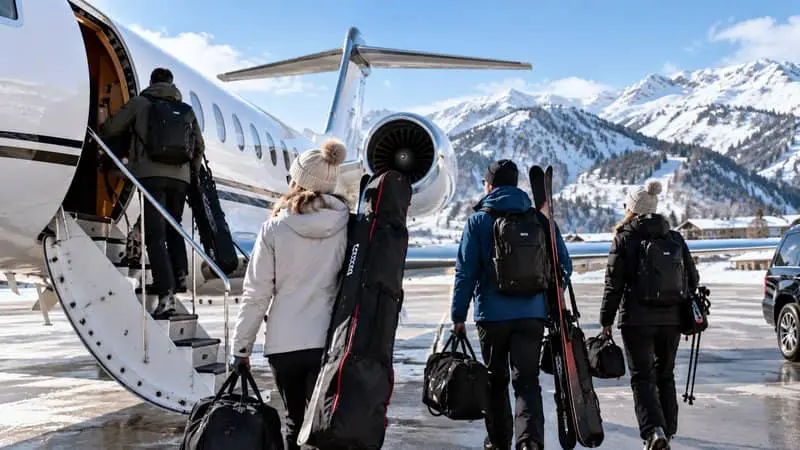
The hardest part of a ski trip can be getting your gear to the mountain in the first place. You may be flying with ski bags, boot bags, helmets, and a stack of outerwear that refuses to compress into a reasonable size suitcase. When you fly on a commercial flight, all that gear means extra fees, tense moments at the baggage carousel, and anxiety about whether your gear will show up before your first run.
Private charter doesn’t make ski equipment any smaller. But it can remove some of the baggage challenges that makes ski travel harder than it needs to be.
Where Commercial Flights Break Down for Ski Travelers
Most ski travel headaches aren’t about the flight itself. They’re about baggage handling.
Airlines charge extra for oversized ski bags, and the fees vary by carrier, route, and how strictly the policy is being applied at that particular gate. When you’re traveling with a group, those fees add up fast, and the inconsistency makes them confusing and frustrating to navigate.
Tight connections create a separate problem. A 45-minute layover is manageable when you’re traveling with a carry-on. When your skis need to transfer between aircraft at a busy hub during that same time window, the odds of them making it can feel considerably lower.
Oversized bags may require separate handling from standard luggage, so a missed connection can create additional logistical complications when the bag needs to be located and transferred. There’s no guarantee they’ll arrive before your first day on the mountain.
Carousel delays add even more frustration. Ski bags and boot bags typically come off on a different belt, sometimes from a separate area of the terminal, and often long after your other luggage. After a long travel day, standing in a second waiting area is the kind of friction that spills into the first hours of a trip that’s supposed to be a vacation.
Damage is a real risk as well. Ski equipment is checked as special baggage and may require different handling from a standard suitcase. A sturdy bag or hard-sided case can provide important protection during transit, but no bag is immune to rough handling across multiple transfers.
How Private Charter Simplifies Ski Travel
An on-demand private jet charter handles your gear differently from the start. You bring your equipment to the aircraft, it gets loaded, and you board. There’s no check-in counter, no oversized bag fees, no queue, and no transfer point where your skis have to survive another carrier’s baggage system.
The absence of a connection is the most meaningful change. On a private charter, your gear is on one aircraft with you for the entire flight. It doesn’t re-enter the baggage system at a connecting airport. When you land, everything comes off the same plane you arrived on.
Simplified check-in also changes how you pack. When you’re not managing fee structures or airline weight policies, you can simply bring what you want for your trip. That alone reduces the planning anxiety that can start a ski trip on the wrong foot.
Matching Your Gear to the Aircraft
Private aircraft vary in how much baggage they can carry, so consider capacity before you book your flight.
Smaller jets work well for two or three people with one bag each. A group of six bringing full ski bags, boot bags, and regular luggage for a week-long trip may benefit from a mid-size or large-cabin aircraft with a more generous baggage area.
Be specific about what you’re bringing when you reach out to book. The goal isn’t simply to make sure everything fits. Baggage requirements can influence which aircraft makes the most sense for the group, particularly when you’re traveling with several people or bringing equipment for a full week on the mountain.
A travel team that knows the details up front can account for those requirements when comparing aircraft, rather than finding out at the last minute that the most convenient option doesn’t have the space you need.
Boots deserve their own mention. They take up significant space on their own and are easy to undercount when estimating baggage. Packing boots in a dedicated bag and listing it separately when you plan gives a more accurate picture of the total load.
Planning for Winter Conditions
Winter flying introduces variables at commercial hubs where weather delays can cascade. One storm can ground connections across a major airport for hours, and a group that’s routed through a busy hub in winter weather may lose an entire day of skiing to a delay that started three connections away from them.
Private routing is more flexible. Rather than funneling through a large commercial hub, you can fly directly to a smaller airport that serves the ski area. Many mountain airports are accessible to private aircraft. Shorter routes with fewer handoffs mean fewer opportunities for the trip to stall. Long-range private jet rentals can skip the need for connections entirely.
Choosing the right arrival airport for the last leg of the trip can mean landing closer to the resort reduces exposure to icy road conditions and significantly cuts the ground transfer time. A two-hour drive from a major airport can become a 20-minute ride from a smaller one.
Effective Coordination Improves a Ski Charter
A ski charter works best when the trip’s moving parts are coordinated as one itinerary. A dedicated travel team can account for the group and its equipment when selecting the aircraft, choose an arrival airport that makes sense for the resort, and arrange ground transportation around the same plan. Each decision affects the next, so coordinating them together can prevent small logistical issues from becoming bigger problems.
Ground transportation is an especially easy detail to overlook. A vehicle that comfortably carries six people may not have room for six sets of skis, boot bags, and regular luggage. Planning the transfer around the actual group and its equipment means the right vehicle is waiting when you land, instead of discovering at the airport that the final leg of the trip can’t accommodate everything.
That coordination also becomes valuable when winter weather changes the plan. If a flight is delayed or the arrival airport needs to change, the ground transfer may need to change with it. Having the aircraft, transportation, and resort transfer organized as one itinerary makes those adjustments easier to manage. The goal is to keep one change from creating problems throughout the rest of the trip.
A Smoother Way to Get to the Slopes
If you’ve ever planned a ski trip for a group, you know the flight is only one part of getting everyone to the mountain. The real question is how much time and effort you want to spend managing everything around it. A private charter gives you more control over that process, from when you leave to where you land and how you get from the airport to the resort.
For a trip you’ve been looking forward to, that can make a meaningful difference. You spend less of the journey managing logistics and more of it on the mountain.