
As your company grows, travel becomes harder in ways that don’t always show up on a spreadsheet right away. One executive books flights one way. Another team uses a different policy. Ground transportation gets handled at the last minute. Then a delay hits, and suddenly three people are solving the same problem from different angles while the meeting clock keeps ticking.
That kind of travel management drains more than time. It chips away at focus and adds avoidable cost. End-to-end travel management becomes necessary as companies grow because increased complexity exposes the limitations of fragmented systems, especially when coordinating higher-stakes options like corporate jet charter services.
Growth Turns Simple Travel Into Operational Work
In a smaller company, travel can stay informal for a while. Executive assistants, or even the travelers themselves, can manage a few trips each month with light schedules and simple routes without causing much trouble.
As the company scales, though, travel starts overlapping. Teams fly to different cities at once. Clients need face time in multiple markets. Leadership wants tighter control over timing and budget. At that point, travel stops being a side task and starts requiring a proper system. Otherwise, problems multiply quickly.
One missed connection can trigger a hotel rebooking and a car service change that leads to a delayed client dinner. If no one owns the full picture, each piece gets handled separately, often too late and at a higher cost.
Booking Travel Separately Drives Up Costs
Many companies think booking travel piecemeal only creates inconvenience. The bigger issue is that it hides waste. When flights, hotels, and ground transport are booked in separate channels, you lose visibility into the total trip and the tradeoffs inside it.
Overfocusing on finding the best first-class flight price may inadvertently create a costly overnight stay. A hotel booking may look fine on rate, but then add an hour of daily transit. It can be easy to choose a flight with a weak connection that forces a same-day rebooking at premium pricing when weather shifts. None of that looks significant in isolation. Together, it becomes expensive.
Centralized travel oversight helps you view the trip as a whole. That is where real savings show up. Rather than optimizing the individual pieces, you can optimize the trip as a whole for much better efficiency.
Reactive Travel Management Wears Teams Down
Reactive travel planning creates decision fatigue. Your people spend energy solving preventable problems instead of preparing for the reason they are traveling. That becomes especially costly for executives and client-facing staff who need to arrive focused.
When travel is handled end-to-end, fewer decisions fall to the traveler in real time. The route is planned with the schedule in mind. Ground transport aligns with arrival times. Backup options have already been considered in case something slips. That does not remove all disruption, but it does mean that when something does go wrong, the plan is already in place and the day can keep moving forward.
A team that travels often does better with consistency. It takes less mental energy when there are no logistics to manage. More energy remains for the work that justified the trip in the first place.
Proactive Planning Protects Time and Risk
Travel problems usually begin in the booking stage, when no one asks the second-order questions. Is this connection too tight for summer weather? Is this airport the right one for the meeting location? Is the hotel close enough to keep the evening useful? Does the return flight leave enough room if the meeting runs long?
Proactive planning catches those issues before they become expensive. It also reduces risk. If an executive is traveling internationally or a team is moving on a time-sensitive schedule, small planning mistakes can produce outsized consequences. Missed connections with weak backup options and poor airport choices can force overnight delays or changed itineraries.
An end-to-end approach makes it easier to build margin into the plan. You can preserve the day instead of hoping it holds together.
Real-Time Support Keeps the Plan Moving
The value of streamlined travel management becomes clear when a trip falls behind schedule. Any number of factors can cause delays that create a chain reaction in minutes. If each part of the trip was booked separately, the traveler often becomes the coordinator by default.
That is where real-time support becomes operationally important. When one team can reroute flights, shift hotel timing, move ground transport, and communicate changes clearly, the disruption stays contained.
Growing companies tend to feel this pain more sharply because their trips often carry more at stake. Senior meetings, revenue conversations, investor touchpoints, and hiring trips all depend on timing. Real-time support keeps one disruption from multiplying.
Travel that Scales with Your Business
When your business reaches a certain size, travel management stops being an occasional administrative function and becomes part of regular operations. Companies that handle it well move more cleanly. Their teams arrive better prepared. Their schedules hold up more often. Their travel spending becomes easier to understand and easier to improve.
That is why growing companies need end-to-end travel management. It proactively makes travel decisions based on a bigger picture to reduce hidden costs and lower the risk of disruption. It gives people a better way to navigate complex itineraries without carrying the full burden themselves.
If your company is traveling more often, across more routes, with more people involved, the question is no longer whether the trip can be booked. The real question is whether the system around the trip is strong enough to keep growth from turning travel into missed opportunities.
Video
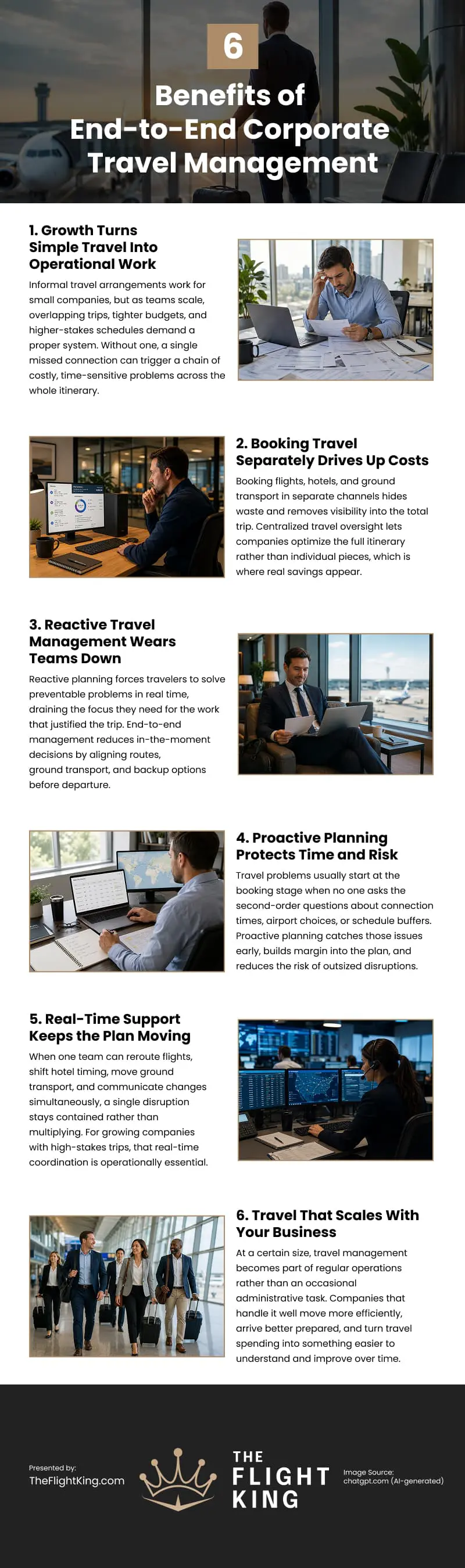
Infographic
As companies grow, corporate travel quickly becomes a complex operational challenge that requires a structured, centralized system to manage costs, reduce risk, and keep high-stakes itineraries running smoothly. Explore the benefits of end-to-end corporate travel management in this infographic.