
When you’re comparing private jets, it’s easy to start with the aircraft category. Light, midsize, super-midsize, and heavy jets give you a useful starting point, but the category alone won’t tell you whether an aircraft is right for your trip.
It’s often more helpful to start with the way you plan to travel. You need enough cabin and baggage space for your group, a layout that works for the flight, and an aircraft that can use an airport that makes sense for your destination. These factors can matter just as much as the size of the jet.
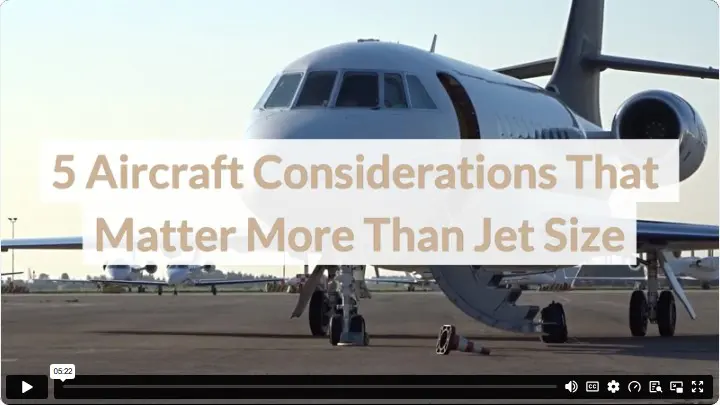
Before you choose an aircraft based on its category, look at these five factors. They can tell you much more about whether a particular jet fits your trip.
1. How Far the Aircraft Can Fly
Range can vary significantly between aircraft in the same size category. Two different midsize jet charters, for example, can have meaningfully different nonstop capabilities. The same is true across other categories. Size gives you a general sense of the aircraft, but range needs to be evaluated on its own.
The published range of an aircraft is not necessarily the range you will get on your trip, either. Passenger count, luggage, weather, routing, and other operating conditions can all affect how far an aircraft can comfortably fly without stopping for fuel. An aircraft that handles a particular route nonstop with a lighter load may need a fuel stop when carrying a full group and substantial luggage.
For shorter domestic routes, those differences may not matter much. On longer international legs, they can determine whether you arrive at your destination without stopping or spend additional time on the ground. A fuel stop can add another operational variable and make your travel schedule less predictable.
Before you choose an aircraft, verify its range for your specific route and passenger load. Treating “midsize,” “super-midsize,” or “large-cabin” as a proxy for range can leave you with an aircraft that only fits in theory.
2. How the Cabin Works for Your Group
Seat count tells you how many people can board. Cabin layout tells you how well it accommodates the people on the flight.
Some aircraft configurations feature individual seats arranged for privacy and rest. Others have face-to-face seating suited for small group conversations or working sessions. Some cabins include a divider that creates a quieter forward section. Others are open throughout. Longer aircraft sometimes have a dedicated sleeping area separate from the main cabin.
The configuration that makes sense depends entirely on how your group will use the time in the air. A team that needs to review materials together may choose a different setup than a family that plans to sleep. A traveler who needs uninterrupted quiet will want different seating than a group on a celebratory trip.
On longer flights, cabin layout also affects how rested your group arrives. A seat that reclines fully into a flat surface is a different experience than one that doesn’t, regardless of how large the aircraft is. A larger cabin cannot compensate for a layout that works against the way your group wants to use the flight time.
3. Whether Your Gear Actually Fits
Baggage space varies considerably across aircraft, and size category gives you only a rough idea of what to expect.
Even the total usable space doesn’t tell the whole story. The shape of the baggage hold and dimensions of the access door also affect how much your group can realistically bring. An aircraft that comfortably seats eight might only carry the luggage of six before running into issues.
Oversized gear amplifies the problem. Ski bags and golf bags are awkward regardless of the aircraft. They’re long, they don’t stack the way suitcases do, and they take up more effective space than their volume alone suggests.
Before booking, be specific about what your group is bringing, including the total number of bags, whether any are oversized, and the combined volume of all luggage. A travel team that has this information upfront can match the aircraft to the actual load rather than approximating and adjusting at departure.
4. Which Airports the Aircraft Can Reach
Smaller airports, often much closer to a destination, are accessible to private jet charters. The catch is that not every private aircraft can use every private-accessible airport. Shorter runways and higher-altitude airfields have requirements that some aircraft meet and others don’t. Smaller, lighter jets are often better suited to those airports than large-cabin, long-range aircraft, which may require a longer runway than a mountain or coastal airstrip can provide.
This creates a tradeoff worth considering early in the planning process. An airport 20 minutes from a ski resort or golf destination has advantages over one that is a two-hour drive. Choosing an aircraft that can land closer to your destination, can significantly reduce travel time once you’re on the ground.
5. The Flying Experience in the Air
The aircraft category doesn’t tell you what the cabin experience will be. A well-equipped midsize jet can offer better seating, connectivity, and cabin amenities than an older large-cabin aircraft. What you’ll actually experience depends on the specific aircraft and how the operator maintains and equips it.
That difference becomes more important as the flight gets longer. On a flight of six hours or more, seat comfort, sleeping arrangements, connectivity, galley capability, and cabin noise can have a noticeable effect on the trip.
Before booking, ask about the specific aircraft and confirm that its cabin amenities match what you need for the flight.
Choosing the Right Aircraft, Not the Right Category
Jet size categories are a useful starting point. They can get you looking in the right direction. But they work best as an opening frame, not the final filter.
A charter decision that starts with the route, group size, baggage, destination airport, and purpose of the flight tends to result in the right aircraft. One that starts with size and works backward tends to compromise on at least one of the factors that actually matter on the day of travel.
The same size category can contain aircraft with very different capabilities, configurations, and operating limitations. A jet that looks ideal on paper may be a poor fit once you account for your actual travel needs. Looking at the details first gives you a much clearer picture of which aircraft makes the most sense.
Video
Infographic